 Add to Chrome
 Add to Firefox
 Add to Edge
Self-Rewarding Sequential Monte Carlo for Masked Diffusion Language Models
Feb 02, 2026
This work presents self-rewarding sequential Monte Carlo (SMC), an inference-time scaling algorithm enabling effective sampling of masked diffusion language models (MDLMs). Our algorithm stems from the observation that most existing MDLMs rely on a confidence-based sampling strategy, where only tokens with the highest prediction confidence are preserved at each step. This restricts the generation to a noise-sensitive, greedy decoding paradigm, resulting in an inevitable collapse in the diversity of possible paths. We address this problem by launching multiple interacting diffusion processes in parallel, referred to as particles, for trajectory exploration. Importantly, we introduce the trajectory-level confidence as a self-rewarding signal for assigning particle importance weights. During sampling, particles are iteratively weighted and resampled to systematically steer generation towards globally confident, high-quality samples. Our self-rewarding SMC is verified on various masked diffusion language models and benchmarks, achieving significant improvement without extra training or reward guidance, while effectively converting parallel inference capacity into improved sampling quality. Our code is available at https://github.com/Algolzw/self-rewarding-smc.

Safe Bayesian optimization across noise models via scenario programming
Dec 12, 2025Safe Bayesian optimization (BO) with Gaussian processes is an effective tool for tuning control policies in safety-critical real-world systems, specifically due to its sample efficiency and safety guarantees. However, most safe BO algorithms assume homoscedastic sub-Gaussian measurement noise, an assumption that does not hold in many relevant applications. In this article, we propose a straightforward yet rigorous approach for safe BO across noise models, including homoscedastic sub-Gaussian and heteroscedastic heavy-tailed distributions. We provide a high-probability bound on the measurement noise via the scenario approach, integrate these bounds into high probability confidence intervals, and prove safety and optimality for our proposed safe BO algorithm. We deploy our algorithm in synthetic examples and in tuning a controller for the Franka Emika manipulator in simulation.
CODE-II: A large-scale dataset for artificial intelligence in ECG analysis
Nov 19, 2025Data-driven methods for electrocardiogram (ECG) interpretation are rapidly progressing. Large datasets have enabled advances in artificial intelligence (AI) based ECG analysis, yet limitations in annotation quality, size, and scope remain major challenges. Here we present CODE-II, a large-scale real-world dataset of 2,735,269 12-lead ECGs from 2,093,807 adult patients collected by the Telehealth Network of Minas Gerais (TNMG), Brazil. Each exam was annotated using standardized diagnostic criteria and reviewed by cardiologists. A defining feature of CODE-II is a set of 66 clinically meaningful diagnostic classes, developed with cardiologist input and routinely used in telehealth practice. We additionally provide an open available subset: CODE-II-open, a public subset of 15,000 patients, and the CODE-II-test, a non-overlapping set of 8,475 exams reviewed by multiple cardiologists for blinded evaluation. A neural network pre-trained on CODE-II achieved superior transfer performance on external benchmarks (PTB-XL and CPSC 2018) and outperformed alternatives trained on larger datasets.
Learning Dynamics from Input-Output Data with Hamiltonian Gaussian Processes
Nov 07, 2025Embedding non-restrictive prior knowledge, such as energy conservation laws, in learning-based approaches is a key motive to construct physically consistent models from limited data, relevant for, e.g., model-based control. Recent work incorporates Hamiltonian dynamics into Gaussian Process (GP) regression to obtain uncertainty-quantifying models that adhere to the underlying physical principles. However, these works rely on velocity or momentum data, which is rarely available in practice. In this paper, we consider dynamics learning with non-conservative Hamiltonian GPs, and address the more realistic problem setting of learning from input-output data. We provide a fully Bayesian scheme for estimating probability densities of unknown hidden states, of GP hyperparameters, as well as of structural hyperparameters, such as damping coefficients. Considering the computational complexity of GPs, we take advantage of a reduced-rank GP approximation and leverage its properties for computationally efficient prediction and training. The proposed method is evaluated in a nonlinear simulation case study and compared to a state-of-the-art approach that relies on momentum measurements.
Robust Convex Model Predictive Control with collision avoidance guarantees for robot manipulators
Aug 29, 2025Industrial manipulators are normally operated in cluttered environments, making safe motion planning important. Furthermore, the presence of model-uncertainties make safe motion planning more difficult. Therefore, in practice the speed is limited in order to reduce the effect of disturbances. There is a need for control methods that can guarantee safe motions that can be executed fast. We address this need by suggesting a novel model predictive control (MPC) solution for manipulators, where our two main components are a robust tube MPC and a corridor planning algorithm to obtain collision-free motion. Our solution results in a convex MPC, which we can solve fast, making our method practically useful. We demonstrate the efficacy of our method in a simulated environment with a 6 DOF industrial robot operating in cluttered environments with uncertainties in model parameters. We outperform benchmark methods, both in terms of being able to work under higher levels of model uncertainties, while also yielding faster motion.
Forward-only Diffusion Probabilistic Models
May 22, 2025This work presents a forward-only diffusion (FoD) approach for generative modelling. In contrast to traditional diffusion models that rely on a coupled forward-backward diffusion scheme, FoD directly learns data generation through a single forward diffusion process, yielding a simple yet efficient generative framework. The core of FoD is a state-dependent linear stochastic differential equation that involves a mean-reverting term in both the drift and diffusion functions. This mean-reversion property guarantees the convergence to clean data, naturally simulating a stochastic interpolation between source and target distributions. More importantly, FoD is analytically tractable and is trained using a simple stochastic flow matching objective, enabling a few-step non-Markov chain sampling during inference. The proposed FoD model, despite its simplicity, achieves competitive performance on various image-conditioned (e.g., image restoration) and unconditional generation tasks, demonstrating its effectiveness in generative modelling. Our code is available at https://github.com/Algolzw/FoD.
Supervised Models Can Generalize Also When Trained on Random Label
May 16, 2025The success of unsupervised learning raises the question of whether also supervised models can be trained without using the information in the output $y$. In this paper, we demonstrate that this is indeed possible. The key step is to formulate the model as a smoother, i.e. on the form $\hat{f}=Sy$, and to construct the smoother matrix $S$ independently of $y$, e.g. by training on random labels. We present a simple model selection criterion based on the distribution of the out-of-sample predictions and show that, in contrast to cross-validation, this criterion can be used also without access to $y$. We demonstrate on real and synthetic data that $y$-free trained versions of linear and kernel ridge regression, smoothing splines, and neural networks perform similarly to their standard, $y$-based, versions and, most importantly, significantly better than random guessing.
Safe exploration in reproducing kernel Hilbert spaces
Mar 13, 2025Popular safe Bayesian optimization (BO) algorithms learn control policies for safety-critical systems in unknown environments. However, most algorithms make a smoothness assumption, which is encoded by a known bounded norm in a reproducing kernel Hilbert space (RKHS). The RKHS is a potentially infinite-dimensional space, and it remains unclear how to reliably obtain the RKHS norm of an unknown function. In this work, we propose a safe BO algorithm capable of estimating the RKHS norm from data. We provide statistical guarantees on the RKHS norm estimation, integrate the estimated RKHS norm into existing confidence intervals and show that we retain theoretical guarantees, and prove safety of the resulting safe BO algorithm. We apply our algorithm to safely optimize reinforcement learning policies on physics simulators and on a real inverted pendulum, demonstrating improved performance, safety, and scalability compared to the state-of-the-art.
Probabilistic Bubble Roadmap
Feb 22, 2025Finding a collision-free path is a fundamental problem in robotics, where the sampling based planners have a long line of success. However, this approach is computationally expensive, due to the frequent use of collision-detection. Furthermore, the produced paths are usually jagged and require further post-processing before they can be tracked. Due to their high computational cost, these planners are usually restricted to static settings, since they are not able to cope with rapid changes in the environment. In our work, we remove this restriction by introducing a learned signed distance function expressed in the configuration space of the robot. The signed distance allows us to form collision-free spherical regions in the configuration space, which we use to suggest a new multi-query path planner that also works in dynamic settings. We propose the probabilistic bubble roadmap planner, which enhances the probabilistic roadmap planner (PRM) by using spheres as vertices and compute the edges by checking for neighboring spheres which intersect. We benchmark our approach in a static setting where we show that we can produce paths that are shorter than the paths produced by the PRM, while having a smaller sized roadmap and finding the paths faster. Finally, we show that we can rapidly rewire the graph in the case of new obstacles introduced at run time and therefore produce paths in the case of moving obstacles.
Efficient Optimization Algorithms for Linear Adversarial Training
Oct 16, 2024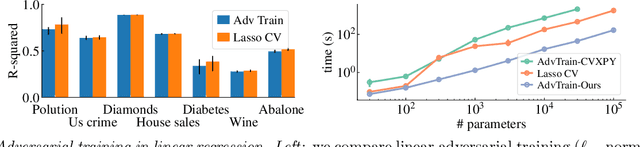
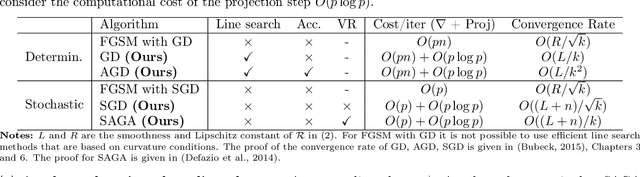
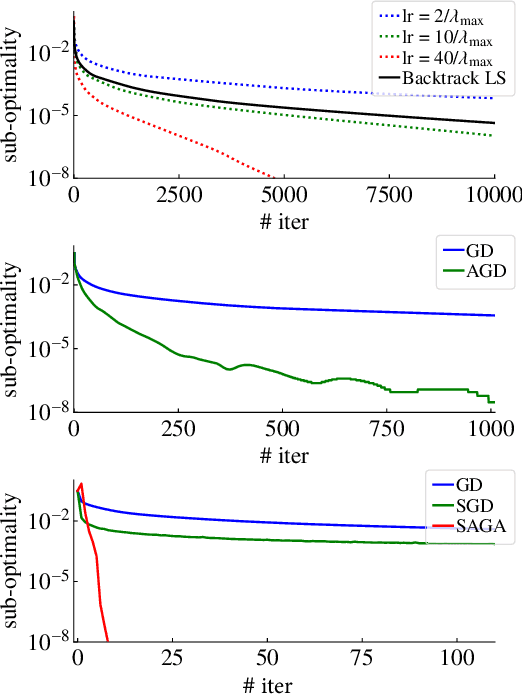
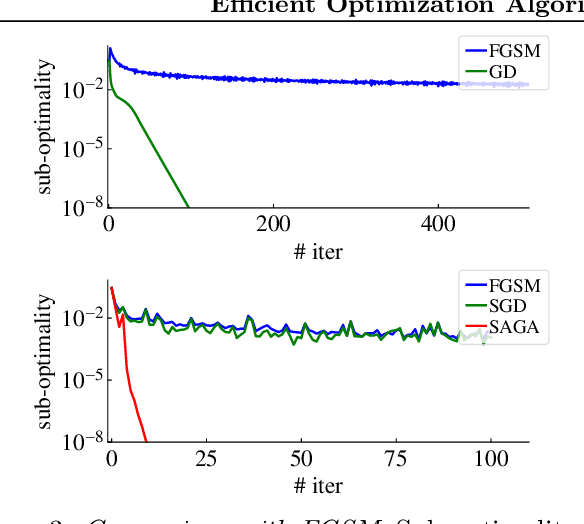
Adversarial training can be used to learn models that are robust against perturbations. For linear models, it can be formulated as a convex optimization problem. Compared to methods proposed in the context of deep learning, leveraging the optimization structure allows significantly faster convergence rates. Still, the use of generic convex solvers can be inefficient for large-scale problems. Here, we propose tailored optimization algorithms for the adversarial training of linear models, which render large-scale regression and classification problems more tractable. For regression problems, we propose a family of solvers based on iterative ridge regression and, for classification, a family of solvers based on projected gradient descent. The methods are based on extended variable reformulations of the original problem. We illustrate their efficiency in numerical examples.